
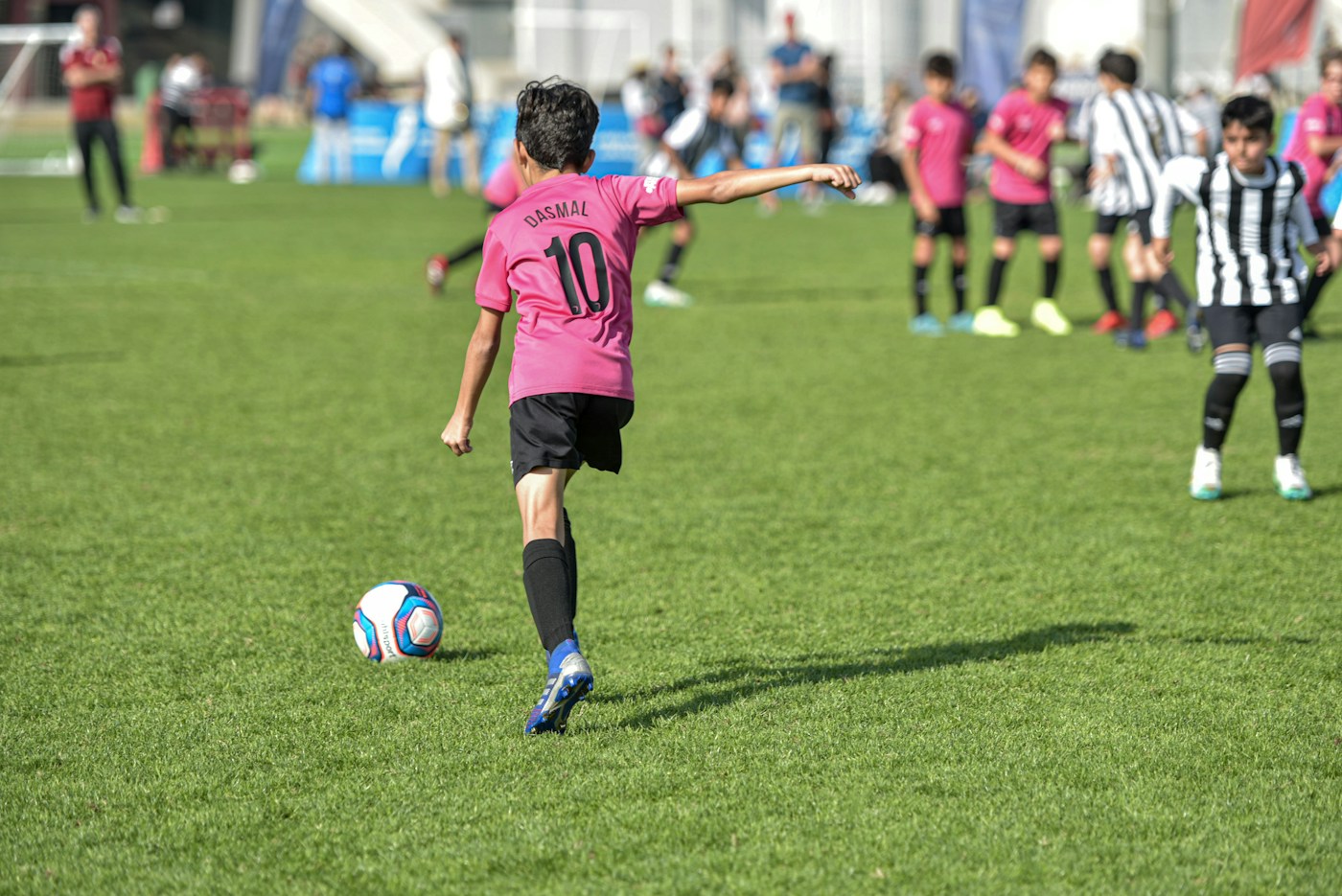
| Focus | Pass, move, and support |
|---|---|
| Equipment | Balls and flat markers |
| Starting groups | Pairs, then groups of three |
| Adjustments | Change space or pressure |
Start with a small game
Set up a safe playing area and begin with a small game. Watch what happens when someone has the ball. Do teammates move where they can receive, or do they stand behind a defender?
Choose one observation to work on. Tell the group, “Today we are making it easier to help the person with the ball.” Keep the opening game short enough to leave time for focused practice and a final game.
Activity one: pass and find a new angle
Players work in pairs with a ball. After passing gently along the ground, the passer moves sideways into a new open angle. The receiver looks up, settles the ball if needed, and returns a pass.
Begin with comfortable distances and no defender. Watch whether the passer moves early enough for the receiver to notice. Change partners so players work with different teammates.
- Easier: shorten the distance and allow more time to control the ball.
- More challenge: ask the receiver to take a first touch toward open space.
- Coach’s question: “Where can you move so I can see you?”
Activity two: two attackers, one defender
Give each group of three a small rectangle and an end line to attack. Two players try to move the ball across the end line under control while one defender tries to win it. Rotate the defender frequently.
If the defender blocks the passing lane, carrying the ball may be useful. If the defender closes the ball carrier, the partner can find a new angle. Let players discover both possibilities.
Widen the area or use a passive defender if the activity stalls. Reduce the space slightly when players need more challenge. Change one feature at a time so you can see its effect.
Finish with a game and one question
Return to a small game where players can choose freely. Notice a moment when someone moves to help, and give specific feedback during a natural pause. Avoid adding touch restrictions just to make the activity look more advanced.
At the end, ask, “What made a teammate easier to pass to?” Record one observation for the next session. In the coach workspace, save the drill with your own player groups and share it with the team before practice.
WORDS YOU CAN USE“Pass, then find a place where you can help again.”
Sources & further learning
Rule facts use the sources below. Activity suggestions and tactical examples are ToopTime’s introductory coaching guidance.
U.S. Soccer: Play-Practice-PlayThis material has not received independent coach or referee review. We are not affiliated with U.S. Soccer or IFAB.